

Tests your doctor might perform:
1. Peak flow test
A peak flow test is a breathing test which uses a Peak Expiratory Flow Meter to measure how fast you breathe air out of your lungs. Your peak flow can be measured over a period of time, even when you are symptom free. A peak flow test can be carried by a healthcare professional or by you at home. For more information on peak flow meters (Peak flow meter – Asthma Society of Ireland).
2. Lung function test (Spirometry)
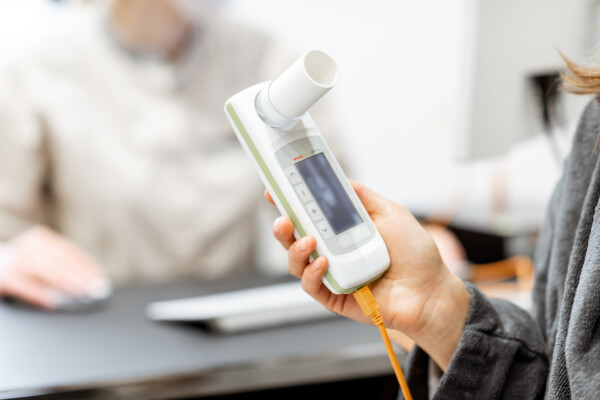
A lung function test (spirometry/pulmonary function) measures your breathing and lung function. It must be carried out by a trained healthcare professional. You will be asked to blow into a spirometer machine which will give you a reading of your lung function.
How is a spirometry test done?
- A spirometry test is done using a small machine attached to a mouthpiece, called a spirometer. The nurse or healthcare assistant can show you how to blow into the spirometer before starting the test. To do the test you need to:
- Sit comfortably.
- Wear a clip on your nose to make sure all the air from your lungs goes into the mouthpiece.
- First do a relaxed breath – it is often described as a big sigh into the machine.
- Then take a deep breath and breathe out as fast and as hard as you can, for as long as you can, through the mouthpiece.
- You will need to blow a few times and put as much effort into the test as you can, to get an accurate result.
- Some people can feel a bit dizzy, lightheaded or faint afterwards, but this usually lasts just a few minutes.
3. Bronchodilator reversibility test
How is spirometry used with a bronchodilator reversibility test (BDR)?
A spirometry test is often done alongside a bronchodilator reversibility test (BDR). A reversibility test compares your lung function reading before and after you have taken asthma medication, to see if there is an improvement.
Spirometry used with a BDR test can show:
- If symptoms might be caused by asthma or asthma-COPD overlap (ACO). ACO is where people have features of both asthma and COPD. If your airways open up well after taking reliever medicine through a spacer, it makes it more likely that you have asthma.
- How well your medicines are working, particularly if your treatment plan has changed.
How is a BDR test done?
- First you do a spirometry test. Your healthcare professional will take note of the results.
- Then you use your reliever inhaler or other bronchodilator medicines.
- You wait 15-20 minutes and then do another spirometry test.
If you use inhalers, you should bring them, and your spacer if you have one, to your appointment.
4. Blood tests
Blood tests to check for eosinophils and allergies may be carried out. Raised eosinophils indicate inflammation in the lungs and allergies test what might trigger your symptoms.
5. Fractional Exhaled Nitric Oxide (FeNO) Test
FeNO test (Fractional exhaled nitric oxide) measures the amount of inflammation in your airways and can also assess how you are responding to your controller therapy.
How to do a FeNO test:
- A FeNO test is done by breathing into a mouthpiece connected to a small handheld monitor. The result appears on the screen.
- You take a deep breath in, then slowly breathe out into the mouthpiece until your lungs are empty.
- The test is quick and easy, taking only a few seconds.
- You may need to repeat it a few times to get an accurate result.
6. Exercise test
An exercise test compares your lung function before and after exercise to check if exercise is triggering your symptoms.
7. Methacholine challenge test
Lung function is compared before and after methacholine is administrated. A methacholine challenge test is sometimes used when asthma is difficult to diagnose. Methacholine is a chemical which is known to trigger asthma.
8. Skin allergy tests
Skin allergy tests may be completed to check what is triggering your symptoms.